History & Use
The story of the KJI reed-making system started a long time ago in a galaxy far, far away—well, actually, Hartford, CT, at the Music Educator’s conference more than 20 years ago.
That’s really where it all started.
Since that conference, Krassimir Ivanov and Justin Miller have been good friends, as well as business partners. A few years ago, they decided to take it a step further, to become collaborators and inventors! They combined Krassimir’s incredible knowledge of reedmaking with Justin’s business and marketing skills.
They saw picture after picture on social media from the reed desks of bassoonists around the world. They saw how proud those bassoonists were of their assortment of tools, machines, cane and other reed-making accessories. They also observed two other things:
- Reed-making desks are cluttered with a wide variety of tools.
- There was no pattern of tools being used to make the reeds.
Everyone was doing things differently—using different stuff to work on the “generic” cane (i.e., 120mm length, 1.27mm gauge and other GP or GSP formats). Seeing this variety, they realized that there was an opportunity to change the reed-making world. Making reeds with so many variables and so many different results was ineffective, and it doesn’t produce high-quality reeds easily or consistently.
Their solution? Design the tools and the cane to work together.
No one had ever done this before, though nearly every bassoonist has thought about it:
- Design & Engineer a set of custom GSP (Gouged, Shaped and Profiled) cane
- Design & Engineer a set of tools to work with the specifically engineered cane
- Develop a system for making reeds using the cane and tools that results in reeds that play with full vibrations as soon as you clip the tip.
And thus, the KJI Reed-Making System was created!
KJI Cane
The heart of the system is the KJI cane. Justin and Krassimir started with three new proprietary shapes, knowing that they needed to appeal to a wide variety of bassoons and bassoon players. Each style of KJI cane would need a variety of performance characteristics to give everyone a good choice for their particular instrument, context and bocal.
They started with the KJI shapers:

KJI Shaper
- Krassimir’s Blend of Rieger 1a and Rieger 2 Shaper
- Wider Tube, Narrower Blade
- Easy Response, Clear Dark Tone, Huge Dynamic Range

JM1 Shaper
- Justin’s Unbranded Shaper from the 1960s
- Narrower Tube, Wider Blade
- Great Flexibility, Dark Sound, Excellent Dynamic Range

JM2 Shaper
- Knochenauer Hybrid
- Wider Tube, Knochenauer Blade
- Easy Playing, Lighter Tonal Balance
Once these shapers were developed, the design of the GSP cane took form. Specifications like Collar/Shoulder location, tip location, cane length, wire placement, tube length, and the profile of the blades were determined for the cane corresponding with the three new shaper designs.
Want to see the details? Click here.
KJI Tools
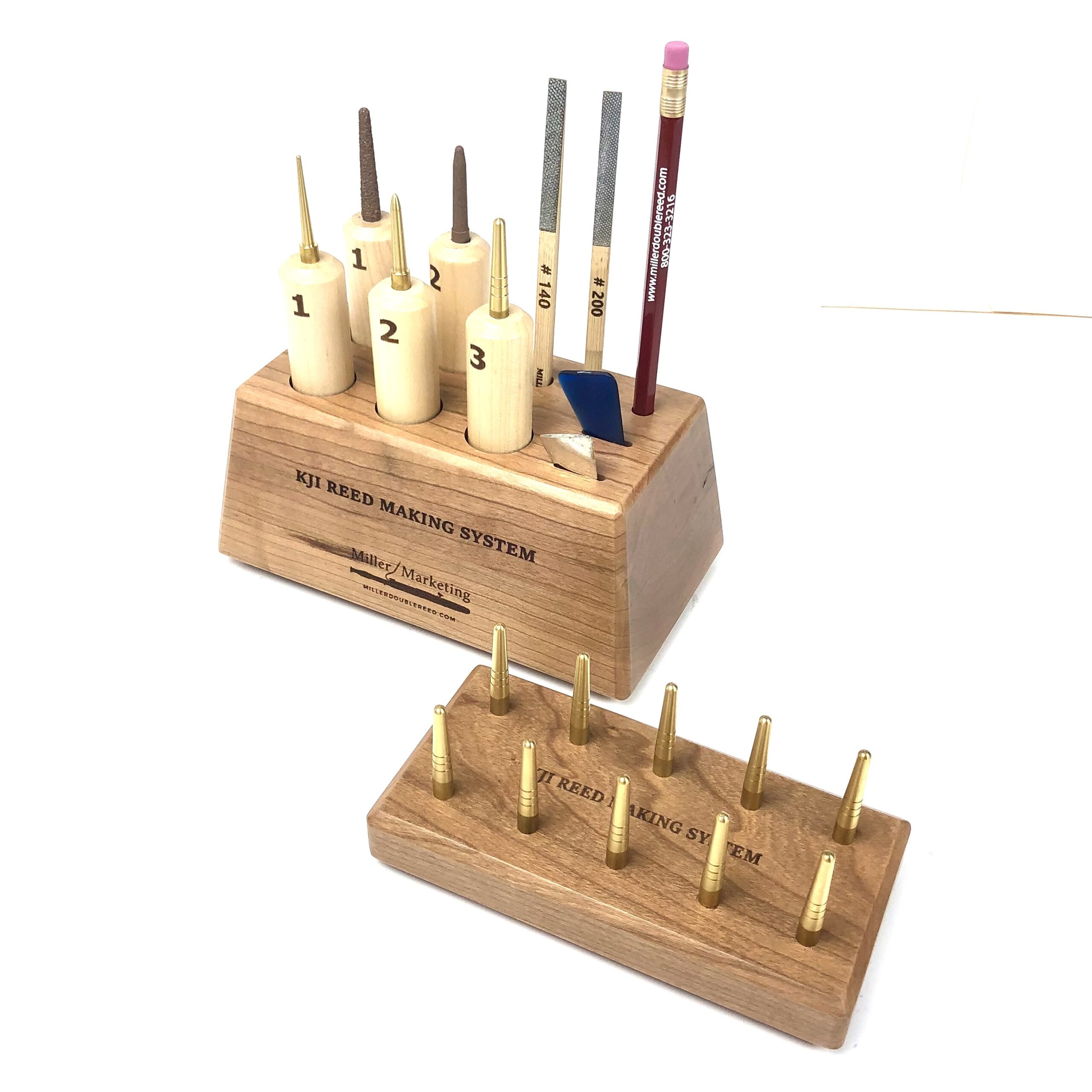
There are three forming mandrels and a drying rack in the KJI Reed-Making System (KJI RMS). All the tools are numbered to indicate the order in which they are used (1,2,3).
Mandrel #1 is a very slender tool that starts the forming process. The tip is small enough to fit inside the blank without damaging the cane. This mandrel is also designed to only go up to the collar/shoulder area without opening up the blade—it has a “stop” to prevent it from going too far, which makes the forming process more consistent than ever.
Mandrel #2 is a little shorter than the first mandrel, but is somewhat thicker. Again, this mandrel has a “stop” to prevent it from going too far in the forming process.
Mandrel #3 is the shortest of all, but has three etched lines to help with consistency in final tube size. Each line corresponds to a different tube size.


The 10-pin KJI RMS drying board serves as the forming rack—each pin is a replica of the Mandrel #3 pin, again for consistency in forming.
Next are the reamers. Reed-making bassoonists know that reamers don’t solve the whole problem. Even the best reamers leave piece of cane behind that need to be filed away. That’s because even the best modern reamers cut across the grain of the cane, causing some cane to be cut, and other cane to be torn. When filing those pieces away, “potholes” are left in the tube, which affects the fit on the bocal and air flow through the reed.
The KJI RMS reamers are designed to eliminate that problem—and two others.
Reamer #1 is a traditional taper reamer. It’s made with a coarse diamond-like coating to establish the basic taper inside the tube. This material leaves the tube perfectly round with a smooth, unpolished surface that grabs the bocal better. There is more surface area and a slight cushion effect after using this reamer. This reamer is designed to fit the diameter at the end of your reed, matching the diameter of YOUR bocal at 7-8mm from the tip. This means your reed doesn’t just fit your bocal—if can fit your bocal perfectly.
Reamer #2 is smaller and smoother. It is designed to go up inside the reed tube and smooth the area around the tip of the bocal, matching the diameter to the tip of your bocal. By adjusting the reed to fit your bocal exactly, you get a good seal, which promotes better resonance and less resistance. None of this is possible with traditional reamers.


After that are the revolutionary diamond files, which are made from polished round diamonds arranged in an organized pattern that leaves space for dust to be cleaned out. The surface of each diamond is smooth, but the round edges are exceptionally crisp and sharp. This allows the file to work very well without a lot of pressure, and it leaves a smooth result. Typical diamond files are randomly-sized diamonds glued to a strip of metal. These traditional files leave a rough surface and are harder to control. The KJI RMS diamond files are attached to a bamboo handle that is lightweight and water-tolerant—all of which gives you a great feel and control while filing your reeds.


Rounding out the KJI RMS are two plaques. The metal plaque is for use with files or sandpaper; the Rieger blue transparent plastic plaque is for use with knives.
And it is all contained neatly in the KJI RMS Tool Holder:
The Tool Holder is made of solid cherry with a natural stain, and helps keep reed desks organized! All the tools are also solid wood (hard maple) and clear-coated with a durable finish over a longer handle than traditional reed tools. That all adds up to more comfort and less fatigue!
The KJI Reed-making system is designed and built in the USA!
The system is sold as a set or by individual tools.
See how it all works together with these step- by-step instructions.
Visit this page to learn more about purchasing this product.